Clust: The Elegant Serif Font Blending Tradition with Modern Versatility
Understanding the Essence of Clust
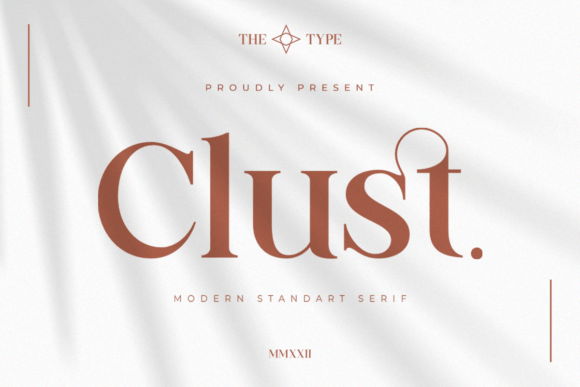
In the vast landscape of digital typography, finding a font that balances classic authority with contemporary flair can be a challenge. Clust rises to meet this challenge, presenting itself as a modern serif typeface deeply inspired by the concepts of elegance and luxury. At its core, Clust is designed to evoke the timeless feeling of traditional serif fonts—the kind you might see in high-end fashion magazines or established financial institutions—while simultaneously offering the flexibility needed for modern digital projects. It is not merely a copy of the past; it is a re-imagining of it for the future.
The defining characteristic of Clust is its duality. It possesses a conservative structure that ensures readability and professionalism in long-form text, making it a reliable choice for body copy. However, the true magic of Clust reveals itself when you explore its extensive set of alternative substitutes and ligatures. These features allow designers to transform the font from a stoic, professional tool into an expressive, playful, and distinctly modern piece of art. Whether you are drafting a formal report or designing a luxury wedding invitation, Clust adapts to the mood you wish to convey.
The Anatomy of Elegance: Features and Characteristics
To truly appreciate what Clust brings to a project, one must look beyond the standard letterforms. The font family has been engineered with a focus on high-end aesthetics. The default letterforms are clean and sharp, featuring the high contrast between thick and thin strokes often associated with luxury branding. This inherent structure gives text set in Clust an immediate air of sophistication.
However, the font’s utility is vastly expanded through its OpenType features:
- Alternative Substitutes: Clust includes a variety of stylistic alternates for specific letters. These variations range from subtle changes in curvature to more dramatic swashes. By swapping out standard letters for their alternates, you can completely change the personality of a headline, making it feel more bespoke and custom-crafted.
- Ligatures: The font features a robust set of ligatures, including standard and discretionary options. These connect specific pairs of letters (like "fi", "fl", or "st") in a way that improves flow and adds a calligraphic touch to the text, enhancing the overall reading experience.
- PUA Encoding: One of the most practical features of Clust is its PUA (Private Use Areas) encoding. This technical specification ensures that every single glyph, swash, and ornament included in the font pack is fully accessible. You do not need advanced design software to use the decorative elements; they can be accessed through standard character maps, making Clust user-friendly for creators of all skill levels.
Real-World Applications: Where Clust Shines
The versatility of Clust makes it a valuable asset across a wide range of industries. Its ability to toggle between conservative and expressive modes means it can serve multiple functions within a single brand identity or project.
Branding and Corporate Identity
For business owners and brand strategists, Clust offers a way to stand out without sacrificing professionalism. In a corporate context, the standard letterforms can be used for annual reports, whitepapers, and website body text to ensure legibility. Meanwhile, the alternate glyphs can be utilized for logos, taglines, and marketing headers to inject personality and distinctiveness into the brand voice. This creates a cohesive visual identity that feels both established and innovative.
Editorial and Web Design
Web designers and content creators will find Clust particularly useful for editorial layouts. The font’s clear, conservative base makes it excellent for reading on screens, reducing eye strain for users consuming long-form content. However, when used for pull quotes or section dividers, the stylistic alternates can break the visual monotony and draw the reader’s eye to key sections of the article. It bridges the gap between functional UX design and artistic expression.
Luxury Goods and Event Stationery
The luxury sector relies heavily on typography to convey exclusivity. Clust fits naturally into this environment. It is an ideal choice for high-end product packaging, jewelry branding, or cosmetic labels. Furthermore, for event stationery—such as wedding invitations, gala programs, or boutique hotel menus—the expressive ligatures and swashes provide a level of detail that mimics custom hand-lettering, offering a premium look at a fraction of the cost.
Evaluating Suitability: Strengths and Considerations
When deciding whether Clust is the right choice for your project, it is helpful to weigh its strengths against practical considerations.
The Strengths
- Uniqueness: The combination of a conservative base with playful alternates allows for a high degree of customization. No two projects using Clust need to look exactly alike.
- Readability: Despite its decorative potential, the font maintains excellent readability. It does not sacrifice function for form, ensuring that your message is always communicated clearly.
- Accessibility of Features: The PUA encoding is a significant advantage for non-designers. It democratizes access to high-end typographic features, allowing business owners to create professional-looking graphics using standard tools.
Considerations and Limitations
While Clust is versatile, it is important to have realistic expectations. As a serif font, it may not pair well with every sans-serif typeface; finding the right combination requires a careful eye for contrast and balance. Additionally, while the font is optimized for text, the highly decorative alternates are best reserved for display sizes (headlines and titles) where the intricate details can be fully appreciated. Using a swash-heavy alternate for small body text could potentially hinder legibility.
Practical Guidance for Implementation
For those looking to integrate Clust into their workflow, a strategic approach yields the best results. Start by establishing the "mood" of your project. If the goal is strictly formal, stick to the default Clust character set. If the goal is creative or luxurious, experiment with the OpenType features.
- Start with Hierarchy: Use the expressive alternates for your H1 and H2 headings to grab attention. Keep the body text in the standard Clust format to ensure a comfortable reading experience.
- Test for Contrast: Clust works beautifully against clean backgrounds. Ensure there is sufficient contrast between the text color and the background to let the elegant details of the serifs pop.
- Explore the Glyphs: Take the time to scroll through the character map. You may find ornamental flourishes or unique letter combinations that serve as perfect design accents for your specific needs.
Conclusion: A Tool for Modern Storytelling
Ultimately, Clust is more than just a collection of letters; it is a tool for storytelling. It allows creators to weave a narrative of elegance, tradition, and modern sophistication through typography. Whether you are a professional designer seeking a flexible serif family or a business owner looking to elevate your brand’s visual presence, Clust provides the necessary toolkit to achieve a polished, high-end result. By balancing the conservative with the expressive, it ensures that your text is not just read, but felt.