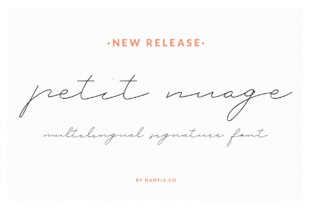
Petit Nuage: A Designer's Guide to a Handwritten Signature Font
In the crowded landscape of digital typography, finding a typeface that feels both personal and professional can be a significant challenge. Petit Nuage enters this space as a decorative signature font, specifically crafted to inject a genuine handwritten feel into modern design projects. It is not merely a script font; it is a stylistic choice that aims to bridge the gap between digital precision and human touch. For designers, marketers, and creators evaluating their typographic toolkit, understanding the nuances of Petit Nuage is essential to determining if it aligns with their aesthetic and functional goals.
Understanding the Core Identity of Petit Nuage
At its heart, Petit Nuage is a typeface that mimics the fluidity and imperfections of natural handwriting. The name, which translates to "Little Cloud" from French, subtly hints at its soft, organic character. Unlike rigid, geometric sans-serifs or formal serifs, this font is built on a foundation of flowing connections and variable strokes. It is designed to evoke emotion, authenticity, and a sense of craftsmanship. The distinctiveness of Petit Nuage lies in its ability to maintain legibility while preserving the casual, unrefined qualities of hand-lettering. This balance is crucial for applications where warmth and approachability are desired without sacrificing clarity.
The font typically features a set of alternate characters and ligatures. These are not just decorative additions; they are functional tools that allow designers to customize text, preventing the repetitive, "typed" look that can plague other script fonts. By swapping out a standard 't' for a stylistic alternate or connecting specific letter pairs with a natural ligature, a designer can make the text appear as though it was written just once, with intention and care.
Comparing Petit Nuage to Other Script Font Categories
When evaluating Petit Nuage, it is helpful to place it within the broader context of script and handwritten fonts. The category is vast, ranging from formal calligraphic scripts to rough, grungy brush fonts. Petit Nuage occupies a specific middle ground. It is more polished and intentional than a chaotic, "scrawled" font, yet less formal and ornate than a classic copperplate script.
- Versus Formal Scripts: Fonts like Edwardian Script or Kuenstler Script convey elegance, tradition, and formality. They are suited for high-end branding, wedding invitations, or legal documents. Petit Nuage, by contrast, is more relaxed and contemporary. It would feel out of place on a black-tie event invitation but perfect for a boutique bakery's logo or a wellness blog's header.
- Versus Casual or Brush Scripts: Many handwritten fonts on the market lean heavily into a raw, energetic, or even messy aesthetic. They are excellent for conveying dynamism, youthfulness, or artistic rebellion. Petit Nuage is more controlled. Its strokes are smoother, and its overall texture is cleaner. This makes it a safer choice for professional contexts where readability is paramount, such as product packaging or website navigation elements.
- Versus Standard Sans-Serifs: The most fundamental comparison is with non-script fonts. A font like Helvetica or Open Sans provides neutrality, universality, and maximum scalability. Petit Nuage is the opposite: it is expressive, niche, and stylistically charged. The choice between them is not about quality but about intent. Do you need to convey information with absolute clarity and no emotional bias? Choose a sans-serif. Do you need to add personality, story, or a human element? That is where Petit Nuage comes in.
Practical Applications and Best-Fit Scenarios
The true value of a font like Petit Nuage is realized in its application. It excels in projects where the goal is to create an emotional connection or a personal brand voice. Consider these realistic use cases:
- Branding for Small Businesses: For a local coffee shop, artisanal goods maker, or independent consultant, Petit Nuage can form the core of a logo or brand mark. It immediately communicates a hands-on, owner-operated feel, differentiating the brand from large, impersonal corporations.
- Editorial and Blog Design: In a magazine layout or a personal blog, this font can be used for pull quotes, section headings, or article titles. It breaks up the monotony of body text, adding visual interest and guiding the reader's eye with a friendly, conversational tone.
- Social Media Graphics: On platforms like Instagram or Pinterest, where visual impact is critical, Petit Nuage can make text overlays on images or quotes stand out. Its handwritten nature feels native to the casual, personal environment of social media.
- Packaging and Label Design: Products that emphasize natural ingredients, homemade quality, or personal care—such as cosmetics, candles, or specialty foods—can benefit from the authentic feel of Petit Nuage. It helps tell the product's story before the consumer even reads the description.
Evaluating Strengths and Considering Tradeoffs
No typographic choice is without its considerations. Petit Nuage's primary strength—its distinctive, decorative character—is also its main limitation. Its very nature makes it less versatile than a foundational workhorse font.
Strengths:
- Emotional Resonance: It instantly adds warmth, personality, and a human touch to any design.
- Modern Aesthetic: It aligns well with current design trends that favor authenticity and organic textures over sterile perfection.
- Customization Potential: With alternates and ligatures, it offers a degree of uniqueness that can prevent a generic look.
Tradeoffs and Limitations:
- Readability at Small Sizes: Like most script fonts, Petit Nuage can become difficult to read when used for body text or at very small point sizes, especially on low-resolution screens.
- Context Sensitivity: Its style is not universally appropriate. It would likely undermine the seriousness of a financial report or a legal contract.
- Overuse Risk: Using it for every headline, subhead, and button on a website can create visual clutter and diminish its impact. It works best as an accent font paired with a clean, simple typeface for longer text.
Making the Decision: Is Petit Nuage Right for Your Project?
Choosing Petit Nuage should be a deliberate decision based on a clear understanding of your project's goals and audience. Ask yourself the following questions:
- What is the primary emotion or message I want to convey? If the answer involves warmth, authenticity, creativity, or personal connection, Petit Nuage is a strong candidate.
- Who is my audience? It resonates well with adults who appreciate craftsmanship and a relaxed, modern aesthetic. It may be less effective for audiences expecting ultra-formal or highly technical communication.
- How will it be used technically? Will it be for large display text or for small, functional UI elements? For the former, it's ideal; for the latter, it could pose usability challenges.
- What is my typographic system? Petit Nuage should not work alone. Consider what complementary font you will use for body copy. A simple, geometric sans-serif or a clean serif will provide necessary contrast and ensure overall legibility.
In conclusion, Petit Nuage is a powerful tool in a designer's arsenal for achieving a specific, highly desirable effect: the handwritten feel. It is not a one-size-fits-all solution, nor is it intended to be. Its value lies in its ability to add a layer of humanity and style to digital and print media where a personal touch is the goal. By carefully evaluating its fit against the project's requirements, audience expectations, and technical constraints, you can make an informed decision that enhances your design's communication and emotional impact. When used thoughtfully and in the right context, Petit Nuage can transform ordinary text into a memorable brand experience.